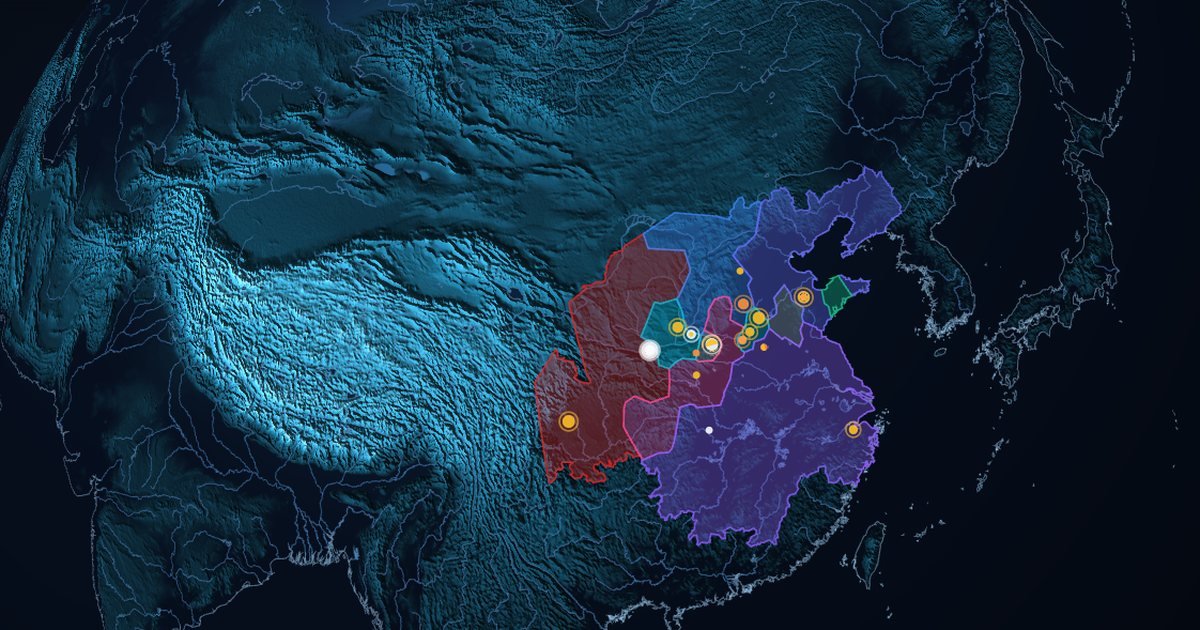
 Play it on the globe →
Two centuries of seven states eating each other until one is left, and then fifteen years in which that one falls apart and is put back together by somebody else. The ground is not drawn by hand: each state is composed from real provinces, cut where a modern border runs through the middle of an ancient one, so the coasts and rivers stay true and only the inland lines are a judgement. Watch the red grow, hold the whole map for twelve years, shatter into eighteen pieces, and come back as another dynasty.
How this is made →70events
1 January 402 BC – 31 December 201 BCspan
Wars & Empirescategory
QinChuQiZhaoWeiHan (韓)YanThe lesser statesThe Han of Liu BangWars and siegesStatecraft and lawThought and inventionWalls and waterworks
What is on the map
- 25 Statecraft and law
- 30 Wars and sieges
- 9 Thought and invention
- 6 Walls and waterworks
Chronology
- The Zhou king recognises the three families that carved up Jin: Zhao, Wei and Han are states now, and there is no longer anyone above themevent▸
- Li Kui writes a code of law for Wei — the first in China to be published rather than kept by the nobles. Every reformer after him copies itevent▸
- The Tian family finishes taking Qi from inside: same state, same capital, another house on the throneevent▸
- Wu Qi is killed by the Chu nobles whose privileges he had cut. Chu goes back to being run by its clans, and never reforms againevent▸
- The last duke of Jin is deposed and the scrap of land left to him divided. The state that had dominated the north for two centuries is deletedevent▸
- Qi opens the Jixia Academy at Linzi and pays philosophers to argue in public. Mencius, Xunzi and most of the Hundred Schools pass through itevent▸
- Duke Xiao of Qin publishes an offer of land and rank to anyone, from any state, who can make Qin strong. A minor official of Wei named Gongsun Yang answers itevent▸
- Shang Yang's first reform in Qin: land to whoever farms it, rank to whoever fights, households registered in fives and responsible for each other. Qin stops being the backward westevent▸
- Guiling: Sun Bin does not march to the besieged city but at Wei's own capital, and beats the Wei army on the road home. It becomes a maximevent▸
- Second reform: the capital moves to Xianyang, land is squared off into fields with paths between, weights and measures made uniform. Qin is now an administration, not a courtevent▸
- Maling: Sun Bin thins his own cooking fires to look like a retreating army, and ambushes Pang Juan in a defile at dusk. Wei is finished as the first powerevent▸
- Shang Yang is torn apart by chariots under the laws he wrote. The laws stay: that is the whole point of themevent▸
- The rulers of Qi and Wei acknowledge each other as king. The Zhou king is still alive in Luoyang and nobody consults himevent▸
- Qin takes the Hexi from Wei and stands on the east bank of the Yellow River. From here it can come down into the plain whenever it likesevent▸
- The duke of Qin calls himself king. Within twenty years all seven have done it, which is how you can tell the old order is overevent▸
- Mencius tells King Hui of Wei that a ruler who wants men to die for him must first see that they eat: benevolence is not sentiment but statecraft. Nobody in power takes him up on itevent▸
- The vertical and horizontal alliances: Su Qin binds six states against Qin, Zhang Yi unpicks them one at a time with promises. Diplomacy becomes a tradeevent▸
- Qin takes Shu and Ba through the Jianmen gorges. It gains the Chengdu basin — grain, salt, iron and a second front against Chu — and roughly doublesevent▸
- Danyang: Chu loses eighty thousand men and the Hanzhong corridor. Qin now holds both ends of the road into the Yangtzeevent▸
- King Wuling of Zhao makes his court wear trousers and ride: infantry in robes cannot chase steppe cavalry. His nobles resist for a year, then Zhao becomes the only state that can fight the Xiongnuevent▸
- Chu swallows Yue and comes out on the eastern sea. It is now the biggest state by far, and the least governedevent▸
- King Huai of Chu goes to Qin to negotiate and is simply kept. He dies a prisoner three years later, and Chu never trusts a Qin invitation againevent▸
- Zhao finishes off Zhongshan, the last state inside its own borders, after twenty years of chipping at itevent▸
- Yique: Bai Qi destroys the joint army of Han and Wei — the sources say two hundred and forty thousand dead. The road east is open and nobody can close itevent▸
- Zhuangzi, offered a ministry, answers that he would rather be a live turtle in the mud than a sacred tortoise on an altar, and goes back to fishingevent▸
- Qin and Qi each take the title of emperor, then both drop it within two months. The word is waiting for someone who can hold itevent▸
- Song is partitioned between Qi, Chu and Wei. With it goes the last buffer: from now on the big states share bordersevent▸
- Yue Yi leads five states into Qi and sacks Linzi, the richest city in China. Qi is reduced to two towns and its bronzes go to Yanevent▸
- Tian Dan ties blades to a thousand oxen, sets their tails alight and drives them into the Yan camp at night. Qi is restored in a season, and never matters againevent▸
- Bai Qi takes Ying, the capital of Chu, and burns the royal tombs. The court flees east to Chen; Chu keeps its size and loses its centreevent▸
- Qu Yuan, exiled and hearing that Ying has fallen, walks into the Miluo with a stone in his arms. He is the first Chinese poet whose name we knowevent▸
- Fan Ju sells Qin a method: swallow what is next to you and befriend what is far away, so that no two enemies are ever fighting you at onceevent▸
- Changping: after three years across the Shangdang ridges Bai Qi cuts the Zhao army from its supplies and starves it for forty-six days. Zhao's field army — the sources say four hundred thousand — is buried after surrenderingevent▸
- Handan holds. Wei and Chu come late but they come, and Qin is thrown back from a capital for the only time in the whole warevent▸
- Li Bing splits the Min river with a stone snout at Dujiangyan: half to the flood channel, half to irrigate the Chengdu plain. It has been working for twenty-two centuries and still isevent▸
- Qin extinguishes Western Zhou and takes the nine cauldrons. The dynasty that had reigned for eight hundred years ends without a battleevent▸
- Xunzi, magistrate at Lanling, argues that men are bad by nature and made good by learning and ritual. Two of his students, Han Fei and Li Si, will build Qin on the first half of that sentenceevent▸
- The last Zhou remnant is absorbed. For the first time in Chinese history nobody at all holds the mandate of heavenevent▸
- The Zheng Guo canal: Han sends an engineer to bog Qin down in a useless waterwork, and he builds one that irrigates forty thousand hectares of Guanzhong. Qin keeps the canal and the engineerevent▸
- Ying Zheng becomes king of Qin at thirteen, with Lü Buwei — a merchant — running the state for himevent▸
- Ying Zheng, now twenty-two, breaks the Lao Ai revolt and forces Lü Buwei out. From here he governs aloneevent▸
- Han Fei, the sharpest legalist writer of the age, dies in a Qin prison — poison sent by Li Si, his old classmate, who had recommended him. The king keeps the booksevent▸
- Han falls in a single season: the weakest of the seven and the closest to Xianyang. Its land becomes Yingchuan commanderyevent▸
- Zhao's king executes Li Mu, the one general Qin could not beat, on the word of a bribed courtier. Handan falls within the yearevent▸
- Handan taken and the king of Zhao captured. His brother escapes north and keeps the name alive as Dai for six more yearsevent▸
- Jing Ke comes to court as an envoy of Yan with a map rolled around a poisoned dagger and a severed head as his credential. He misses; Ying Zheng runs round a pillar and livesevent▸
- Wang Ben turns the Yellow River onto Daliang and holds it there for three months. The city dissolves, a hundred thousand die, and Wei surrendersevent▸
- Wang Jian takes six hundred thousand men into Chu and then does nothing for a year, until the Chu army gives up waiting and moves. Xiang Yan is killedevent▸
- Shouchun falls and King Fuchu is taken. Chu — the biggest of the seven, half the map two centuries earlier — is a commanderyevent▸
- Yan is run down to the Liaodong peninsula and its last king captured. Dai goes the same week: six states down, one to goevent▸
- Qi surrenders without a battle. Its king had been advised by a chancellor on the Qin payroll for years; he is exiled to a forest and left to starveevent▸
- Ying Zheng takes a title nobody had used: First Emperor. The nobility is not restored, the empire is cut into thirty-six commanderies, and governors are appointed and recalled from the capitalevent▸
- One script, one set of weights and measures, one axle width so carts fit the same ruts. The walls between the old states are pulled down and their aristocracies moved to Xianyangevent▸
- Imperial roads out of Xianyang, built to a fixed width with trees along them, and the old state fortifications quarried for the materialevent▸
- Meng Tian is sent north with three hundred thousand men to link the old state walls into one line against the Xiongnu, and to hold the Ordos loop behind itevent▸
- The Lingqu canal joins the Xiang to the Li across a watershed — the first contour canal anywhere — so that grain can float from the Yangtze to the armies in the far southevent▸
- On Li Si's proposal the histories of the other states, the odes and the documents are called in and burned. Only manuals — medicine, farming, divination — and the Qin records are sparedevent▸
- Seven hundred thousand conscripts on the tomb at Mount Li: an army of terracotta, each face different, and rivers of mercury. It will be found by a man digging a well in 1974event▸
- The First Emperor dies at Shaqiu on tour, looking for the drug of immortality. His death is hidden for two months while Li Si and the eunuch Zhao Gao forge a successionevent▸
- Nine hundred conscripts marching to the frontier are stopped by floods, and know the penalty for arriving late. Chen Sheng asks whether kings and nobles are born to it, and they turn roundevent▸
- Chen Sheng is dead within the year, killed by his own driver, but the rising does not stop: every old royal house has someone claiming its throne againevent▸
- Julu: Xiang Yu crosses the river, sinks his boats and breaks his cooking pots so there is nothing to go back to, and destroys the main Qin field armyevent▸
- Liu Bang comes through the Wu Pass and takes Xianyang almost unopposed. Ziying, king of Qin for forty-six days, surrenders on the roadevent▸
- The feast at Hong Gate: Xiang Yu has Liu Bang at his table and lets him leave to relieve himself. It is the most consequential unfinished murder in Chinese historyevent▸
- Xiang Yu burns Xianyang — the palaces are said to have smoked for three months — and cuts the empire into eighteen kingdoms, keeping the title of hegemon and the east for himselfevent▸
- Pengcheng: Liu Bang takes Xiang Yu's capital while he is away and is thrown out of it the same day by thirty thousand cavalry. He escapes with a few dozen ridersevent▸
- Han Xin puts his army with its back to a river at Jingxing so it cannot run, and destroys a Zhao force many times its size. The north changes sidesevent▸
- The two sides divide the empire along the Honggou canal and swear peace. Liu Bang breaks it within weeks, on advice, because Xiang Yu is short of grainevent▸
- Gaixia: surrounded, Xiang Yu hears his own Chu songs sung in the enemy camp and understands that his country has gone over. He breaks out with twenty-eight men and dies at the Wu riverevent▸
- Liu Bang, a village constable who could not read, is proclaimed emperor. He keeps Qin's commanderies, its laws and its roads, drops the terror, and the arrangement lasts four hundred yearsevent▸
Background reading: the parent article.
Other stories
Genghis KhanFrom a boy on the Onon to the Caspian, c. 1162–1227How America Filled UpEvery American city of 60,000 people, in the year it beganMagellan's CircumnavigationFive ships out, one ship home, 1519–1522Marco Polo's TravelsVenice to Xanadu and back, 1271–1295NapoleonFrom Ajaccio to Saint Helena, 1769–1821Nuclear detonationsEvery recorded nuclear test, 1945–1998Out of AfricaHow one species took the whole planet, 300,000 BC – AD 1300The American Civil WarOne country, torn in two and taken back battle by battle, 1860–1865The Black DeathSix years, and a third of Europe, 1346–1353The First World WarSarajevo to Versailles, five years to the dayThe Gallic WarsCaesar's conquest of Gaul, 58–50 BCThe Hundred Years' WarFrom the seizure of Aquitaine to the fall of Bordeaux, 1337–1453The Second World WarFrom the Marco Polo Bridge to Tokyo Bay, 1937–1945The Unification of JapanFrom the Ōnin War to the fall of Osaka, 1467–1615Volcanic EruptionsEvery significant eruption on record since 1500