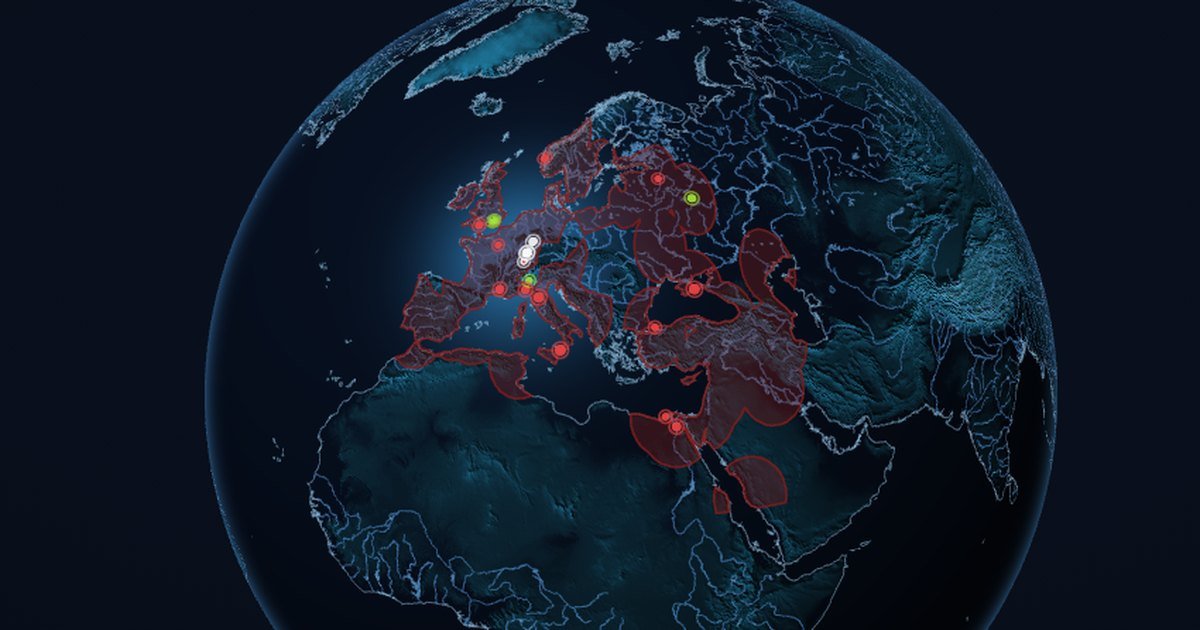
 Play it on the globe →
The only story here where the colour is not who rules but where it has reached — one shade, advancing, never once going back. It is not drawn from an atlas: the evidence is the dated arrival in each of seventy cities, and the ground is whatever lies nearest to one of them, so the map only moves when a source says it moved. Watch the holes as much as the spread — Milan walled up the infected houses and came through almost untouched. And watch the massacres, which in more than one city arrive months before the plague does: fear travelled faster than the disease.
How this is made →21events
1 January 1346 – 31 December 1353span
Earth & Naturecategory
Reached by the plagueThe plague arrivesMassacresWhat was left
What is on the map
- 13 The plague arrives
- 4 Massacres
- 4 What was left
Chronology
- The Mongol army besieging the Genoese colony of Caffa is dying of plague, and catapults its own corpses over the walls. The Genoese sail home. Whether or not the story is literally true, the ships areevent▸
- Constantinople. The emperor John VI Kantakouzenos writes an account of the disease that killed his own son, modelled on Thucydides on the plague of Athensevent▸
- Twelve Genoese galleys put in at Messina with dying men at the oars. The Messinese drive them out of the harbour, and it is already too lateevent▸
- Alexandria. The plague is moving through the Islamic world at the same time and by the same ships, and the Arabic chroniclers describe it as carefully as the Italiansevent▸
- Genoa, Venice, Pisa and Marseille in the same weeks: the plague does not creep overland, it arrives in port. Every place that trades gets it firstevent▸
- Avignon, where the popes then lived. Clement VI has two fires kept burning in his room and sits between them all summer; he survives. He also issues two bulls forbidding the killing of Jewsevent▸
- Florence loses perhaps half its people. Boccaccio sets the Decameron here: ten young people leave the city for a villa and tell stories for ten days, because there is nothing else to doevent▸
- A ship from Gascony lands at Melcombe in Dorset. England has about four million people and will lose between a third and a half of themevent▸
- Paris. The medical faculty is asked for a cause and blames a conjunction of Saturn, Jupiter and Mars in 1345 that corrupted the air. It is the best answer available, and it is wrongevent▸
- Milan walls up the first infected houses with the sick inside and comes through almost untouched — the only large Italian city to do so. It is the earliest quarantine that worked, and it was monstrousevent▸
- Cairo, the largest city west of China, loses perhaps a third of six hundred thousand people. The Mamluk state never recovers the revenueevent▸
- The rumour that Jews have poisoned the wells spreads faster than the disease. Confessions are extracted under torture at Chillon and copied from town to town ahead of the plague itselfevent▸
- Basel burns its Jewish community on an island in the Rhine. The plague has not reached the city yet: it will arrive four months laterevent▸
- Strasbourg. The council that opposed the killing is deposed, and about two thousand Jews are burned in the cemetery on Saint Valentine's day. The plague reaches the city five months afterwardsevent▸
- Now the plague arrives in Basel, four months after the burning. The wells had nothing to do with itevent▸
- The flagellants reach the cities: thousands walking from town to town whipping themselves in public for thirty-three days. Clement VI condemns them in October; the movement is suppressed within a yearevent▸
- Mainz and Cologne, in the same weeks: two of the oldest Jewish communities in Europe are annihilated. By 1351 sixty large communities and a hundred and fifty smaller ones no longer existevent▸
- A ship out of England drifts into Bergen with a cargo of wool and a dead crew. Norway loses perhaps half its population, and some mountain farms are simply never reoccupiedevent▸
- The Statute of Labourers tries to hold wages at what they were before the plague. It fails: with a third of the workforce dead, whoever is left can name a price, and the old order of service cannot be legislated backevent▸
- Novgorod and Pskov. Having gone round Europe clockwise in five years, the plague arrives at the Russian cities from the north-west — a few hundred kilometres from Caffa, where it startedevent▸
- Moscow, and the first wave is over. Between a quarter and a half of Europe is dead. The plague will come back roughly every generation for the next three hundred yearsevent▸
Background reading: the parent article.
Other stories
Genghis KhanFrom a boy on the Onon to the Caspian, c. 1162–1227How America Filled UpEvery American city of 60,000 people, in the year it beganMagellan's CircumnavigationFive ships out, one ship home, 1519–1522Marco Polo's TravelsVenice to Xanadu and back, 1271–1295NapoleonFrom Ajaccio to Saint Helena, 1769–1821Nuclear detonationsEvery recorded nuclear test, 1945–1998Out of AfricaHow one species took the whole planet, 300,000 BC – AD 1300The American Civil WarOne country, torn in two and taken back battle by battle, 1860–1865The First World WarSarajevo to Versailles, five years to the dayThe Gallic WarsCaesar's conquest of Gaul, 58–50 BCThe Hundred Years' WarFrom the seizure of Aquitaine to the fall of Bordeaux, 1337–1453The Second World WarFrom the Marco Polo Bridge to Tokyo Bay, 1937–1945The Unification of JapanFrom the Ōnin War to the fall of Osaka, 1467–1615Volcanic EruptionsEvery significant eruption on record since 1500