 Play it on the globe →
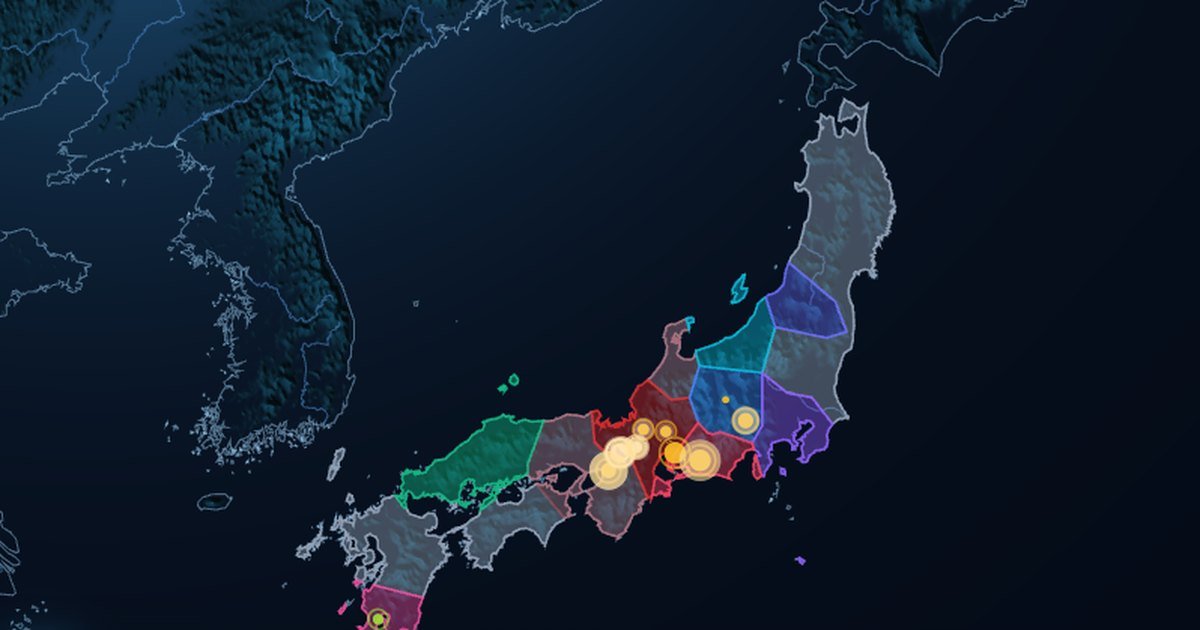
A century and a half in which the country breaks into dozens of domains and three men in a row put it back together. The ground is not drawn by hand: each house is a list of real castles, and the territory is whatever lies nearest to one — so the coasts are true and only the inland lines are a judgement. Watch a mosaic resolve into one colour, and note the date it takes: one afternoon in the fog at Sekigahara.
How this is made →52events
28 May 1467 – 4 June 1615span
Wars & Empirescategory
OdaToyotomiTokugawaTakedaUesugiHōjōMōriShimazuDateImagawaThe other housesJoseon and MingBattles and siegesRule and lawGuns, ships and foreignersFaith and culture
What is on the map
- 25 Battles and sieges
- 3 Faith and culture
- 17 Rule and law
- 7 Guns, ships and foreigners
Chronology
- The Ōnin War begins as a succession quarrel and burns Kyoto for ten years. When it ends nobody has won, and nobody obeys the shogun any moreevent▸
- The Ōnin War ends after eleven years with no winner, no treaty and no capital left standing. The armies simply go home — to provinces they now intend to keep for themselvesevent▸
- The Ikkō league drives out the governor of Kaga and runs the province itself, by congregation and assembly. Peasants and priests will hold it for ninety-three years — «the province owned by peasants»event▸
- Hosokawa Masamoto deposes the shogun and installs a cousin. It is the deputy replacing his master, and after this nobody pretends the shogunate appoints anyoneevent▸
- A masterless samurai takes Odawara by inviting the lord to a hunt and never letting him back in. Hōjō Sōun starts a house that will hold the Kantō for a century — gekokujō, the low overturning the highevent▸
- Two rival Japanese trade missions brawl in Ningbo and burn part of the city. China closes the official trade, and what is left goes to smugglers and to the wokou piratesevent▸
- A Chinese junk carrying Portuguese traders is blown onto Tanegashima. Within a decade Japanese smiths are making matchlocks better than the originals, and war changes shapeevent▸
- Francis Xavier lands at Kagoshima. In fifty years there will be three hundred thousand Japanese Christians, and then an edictevent▸
- Takeda Shingen and Uesugi Kenshin begin fighting over the Kawanakajima plain. They will do it five times in twelve years and settle nothingevent▸
- Okehazama: Imagawa Yoshimoto marches on Kyoto with twenty-five thousand men and stops to view severed heads in a gorge. Nobunaga attacks in a thunderstorm with two thousand and kills himevent▸
- A hostage since childhood, Matsudaira Motoyasu goes home to Okazaki and allies with the man who killed his overlord. He will later call himself Tokugawa Ieyasuevent▸
- Nobunaga takes Inabayama, renames it Gifu after the hill where the Zhou began, and starts sealing letters «tenka fubu» — the realm under one swordevent▸
- Nobunaga enters Kyoto and installs Ashikaga Yoshiaki as shogun. Everyone understands who is holding whomevent▸
- Anegawa: Nobunaga and Ieyasu break the Asai and Asakura, the first time the two future rivals fight side by sideevent▸
- Nobunaga burns Enryaku-ji on Mount Hiei, a monastery-fortress eight hundred years old, and kills everyone on it. The warrior monks are never a power againevent▸
- Takeda Shingen, the one general Nobunaga feared, dies on campaign. His army turns round and goes home, and the road to Kyoto stays openevent▸
- Yoshiaki is expelled and the Ashikaga shogunate simply stops. Two hundred and thirty-five years of Muromachi end without a battle worth the nameevent▸
- Nagashino: three thousand matchlocks behind palisades against the finest cavalry in Japan. The Takeda charge eight times and are annihilatedevent▸
- Azuchi Castle rises on Lake Biwa: seven storeys, gold leaf, a keep meant to be looked at rather than defended. The first castle built as an argumentevent▸
- Free markets, guilds abolished, tolls torn down on the roads Nobunaga controls. Rakuichi-rakuza: whoever wants to trade may tradeevent▸
- Ishiyama Hongan-ji surrenders after eleven years. The fortress of the Ikkō sect held longer than any castle in Japanese history; Osaka Castle will be built on its foundationsevent▸
- The Takeda are hunted down and extinguished. Katsuyori kills himself in the mountains with the last forty men of a house that had terrified the countryevent▸
- Honnō-ji: Akechi Mitsuhide turns his army on his own lord at dawn. Nobunaga, with thirty guards, sets the temple alight and dies in it. Nobody has ever found the bodyevent▸
- Yamazaki: Hideyoshi force-marches two hundred kilometres in seven days and destroys Mitsuhide thirteen days after the murder. Mitsuhide is killed by bandits while fleeingevent▸
- Shizugatake: Hideyoshi beats Shibata Katsuie and inherits everything. A man born to a foot soldier is now the strongest in Japanevent▸
- Osaka Castle begun on the ashes of the Hongan-ji: the largest fortress ever built in Japan, and the one his son will die inevent▸
- Komaki and Nagakute: Hideyoshi cannot beat Ieyasu in the field, so he makes him an ally by marriage instead. It is the most consequential draw in Japanese historyevent▸
- Chōsokabe Motochika, who had taken all of Shikoku, submits to a hundred thousand men landing on four beaches at onceevent▸
- Hideyoshi is made kampaku, imperial regent. He cannot be shogun — that needs Minamoto blood — so he takes a court title instead and outranks everyoneevent▸
- The Shimazu, who had nearly taken all Kyūshū, surrender to an army five times theirs and are left Satsumaevent▸
- The same month, Hideyoshi orders the missionaries out. It is barely enforced for a decade — the trade is too valuable — but the direction is setevent▸
- The sword hunt: every blade in peasant hands is collected, to be melted, it is said, into nails and bolts for a great statue of the Buddha. Farmers stop being soldiersevent▸
- Odawara: two hundred thousand men sit around the Hōjō for three months with tea masters, courtesans and a papier-mâché castle built overnight to break morale. Japan is unifiedevent▸
- Ieyasu is rewarded with the Hōjō lands — and moved four hundred kilometres from his own. He picks a fishing village with a ruined fort: Edoevent▸
- Separation of the classes: samurai to the castle towns, farmers to the fields, and no moving between them. The society that will last until 1868 is set by decreeevent▸
- Hideyoshi demands that Korea let his armies march through, because the country he means to conquer is Ming China. He writes to Manila and Goa as well, telling them to submit. Korea refuses the roadevent▸
- Sen no Rikyū, who made the tea ceremony what it is, is ordered to disembowel himself by the man who employed him. The reason has never been establishedevent▸
- A hundred and sixty thousand men land at Busan — the largest overseas expedition Japan will mount until the twentieth century. Seoul falls in three weeks, Pyongyang in two months, and the plan is to keep going to Beijingevent▸
- Hansando: Yi Sun-sin traps the Japanese fleet in a crane-wing formation and destroys it. The army in Korea is now an army that cannot be supplied by seaevent▸
- Forty thousand Ming troops retake Pyongyang with siege artillery. From this day it is not an invasion of Korea any more: it is Japan against China, fought on Korean groundevent▸
- The second invasion never leaves the southern provinces and bleeds the western lords who are made to pay for it. They will remember at Sekigaharaevent▸
- Twenty-six Christians are crucified at Nagasaki. The edict of 1587 is no longer a piece of paperevent▸
- Hideyoshi dies at Fushimi, leaving a five-year-old heir and five regents sworn to protect him. The oldest and richest of the five is Tokugawa Ieyasuevent▸
- Noryang: the last Japanese convoy is caught leaving. Yi Sun-sin wins and is shot dead in the same hour, and tells his nephew to keep the drum beating so the fleet will not knowevent▸
- A Dutch ship, the Liefde, drifts ashore with eighteen survivors. One is an English pilot, William Adams, who will become Ieyasu's adviser and never see England againevent▸
- Sekigahara: eighty thousand a side in fog and mud, and at midday Kobayakawa changes sides on the hill. Six hours decide who rules Japan for two and a half centuriesevent▸
- Ieyasu is proclaimed shōgun. The bakufu he sets up at Edo will govern for two hundred and sixty-five yearsevent▸
- After two years Ieyasu resigns in favour of his son and keeps all the power. The point is to show that the title is hereditary and the Toyotomi will never get it backevent▸
- Satsuma invades the Ryūkyū kingdom, which goes on paying tribute to China while paying it to Kagoshima as well. It suits everyone for two hundred yearsevent▸
- The winter siege of Osaka: Ieyasu makes peace on condition the outer moats are filled in, then fills in the inner ones too while the ink driesevent▸
- The summer siege ends with the castle burning and Hideyori dead inside. The last army that could oppose the Tokugawa no longer existsevent▸
- The Buke shohatto: what a lord may build, whom he may marry, how many castles he may keep — one. The wars do not end because everyone is tired, they end because they are made illegalevent▸
Background reading: the parent article.
Other stories
Genghis KhanFrom a boy on the Onon to the Caspian, c. 1162–1227How America Filled UpEvery American city of 60,000 people, in the year it beganMagellan's CircumnavigationFive ships out, one ship home, 1519–1522Marco Polo's TravelsVenice to Xanadu and back, 1271–1295NapoleonFrom Ajaccio to Saint Helena, 1769–1821Nuclear detonationsEvery recorded nuclear test, 1945–1998Out of AfricaHow one species took the whole planet, 300,000 BC – AD 1300The American Civil WarOne country, torn in two and taken back battle by battle, 1860–1865The First World WarSarajevo to Versailles, five years to the dayThe Gallic WarsCaesar's conquest of Gaul, 58–50 BCThe Hundred Years' WarFrom the seizure of Aquitaine to the fall of Bordeaux, 1337–1453The Second World WarFrom the Marco Polo Bridge to Tokyo Bay, 1937–1945Volcanic EruptionsEvery significant eruption on record since 1500